

Skin Cancer on the Scalp: Signs, Risks and How to Check
Most people check their arms, their face and their back. Very few check the top of their head, and almost nobody can do it properly on their own. That blind spot is a large part of why scalp skin cancers are picked up at a later stage than skin cancers found anywhere else on the body.
This article covers what skin cancer on the scalp looks like, why it goes unnoticed for so long, who carries the most risk, and how to check an area you cannot see.
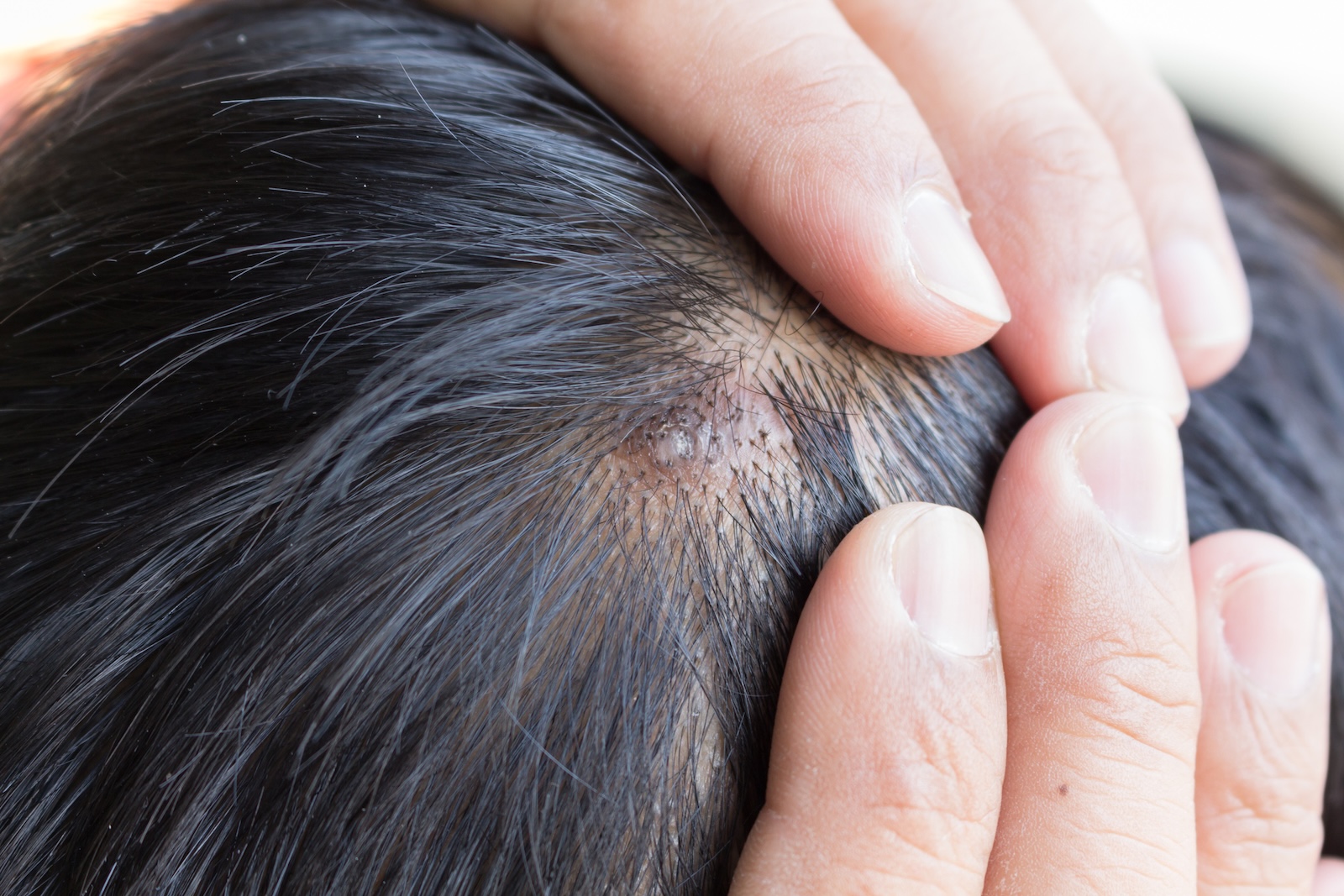
Why Scalp Skin Cancer Is Often Found Late
The scalp collects some of the heaviest lifetime UV exposure of anywhere on the body. It sits closest to the sun, it is rarely covered in sunscreen, and hair gives less protection than most people assume, particularly along the part line and across the crown.
Detection is the harder problem. A new spot on the forearm gets noticed within days. A spot sitting under hair can go unnoticed for months, and sometimes years.
That delay shows up clearly in the research. One analysis of scalp melanomas found a median thickness of 2.1mm at diagnosis, compared with 0.85mm for melanomas elsewhere on the head and neck. Ulceration was present in 22.9 per cent of scalp cases against 10.3 per cent of non-scalp cases, and scalp location was the strongest predictor of recurrence in the study (Palacios-Diaz et al., 2023). Thickness at diagnosis is one of the most reliable predictors of how a melanoma will behave, which is why a delay of a few months matters more here than almost anywhere else on the body.
What Does Skin Cancer on the Scalp Look Like?
Scalp lesions rarely announce themselves. More often they are found by a hairdresser, a partner, or by touch while washing hair. The following changes are worth acting on:
- A spot that bleeds when you brush, comb or wash your hair
- A rough, scaly or crusted patch that appears to heal and then comes back in the same place
- A firm lump or raised bump that catches on a comb or hairbrush
- A sore on the scalp that has not healed after three to four weeks
- A mole that has changed in size, shape, colour or texture
- A patch of scalp that feels tender, numb or itchy without an obvious cause. On the scalp this is easy to put down to dandruff or dry skin, but itching can be a warning sign when it stays in one place for weeks
None of these confirm a skin cancer. Each one is a reason to have the area looked at properly rather than watched for another few months. If the change is to an existing mole, our guide on how to tell if a mole is cancerous walks through the ABCDE framework in detail.
The three main types, and how they present on the scalp
The same three main types of skin cancer that appear elsewhere on the body also appear on the scalp, though they can look different under hair.
| Type | How it usually appears on the scalp | Who it most affects |
|---|---|---|
| Basal cell carcinoma | A pearly or waxy bump, a flat scar-like patch, or a sore that bleeds, scabs and returns | Anyone with heavy cumulative sun exposure, most often over 50 |
| Squamous cell carcinoma | A firm red nodule, or a thick scaly crusted patch, often developing on existing sun-damaged skin | More common on balding or thinning scalps and in people who are immunosuppressed |
| Melanoma | A new or changing dark spot, though nodular melanoma on the scalp can be pink, red or skin-coloured rather than dark | Men over 60 account for the majority of scalp melanoma cases |
The scalp is also a common site for actinic keratosis, a rough scaly patch caused by years of sun exposure. It is considered a precancerous lesion and can progress to squamous cell carcinoma if it is left alone. Persistent rough patches on a balding scalp are worth having assessed rather than treated as dry skin.
Who Is Most at Risk of Scalp Skin Cancer?
Scalp skin cancer can develop in anyone, but several factors raise the likelihood:
- Being male. Studies of scalp melanoma consistently find around three quarters of cases occur in men, with a median age in the early seventies (Palacios-Diaz et al., 2023).
- Thinning hair, a receding hairline, a shaved head, or male pattern hair loss, all of which remove the partial shading hair provides
- Outdoor work or recreation without a broad-brimmed hat
- Fair skin, light or red hair, and a history of sunburn
- Existing actinic keratoses or a previous skin cancer anywhere on the body
- Long-term immunosuppression, including organ transplant recipients and people on immunosuppressant medication
Higher risk does not make a diagnosis inevitable. It does mean the scalp deserves the same attention as the face and arms rather than being skipped because it is hard to see.
How to Check Your Own Scalp for Skin Cancer
A scalp check takes about five minutes and is worth doing every three months. It works best with a second pair of hands.
- Use two mirrors. Stand with your back to a bathroom mirror and hold a hand mirror up to see the crown and the back of your head.
- Work in sections. Use a comb, or a hairdryer on a cool setting, to part the hair in rows from front to back, then again from side to side, so you are looking at skin rather than hair.
- Feel as well as look. Run your fingertips slowly across the whole scalp. Many scalp cancers are picked up by touch first, as a rough patch or a firm lump that was not there before.
- Check the edges. Include the hairline, the part line, the tops and backs of the ears, and the back of the neck. These areas get sun even when the rest of the scalp is covered.
- Ask for help. A partner, a family member or your hairdresser can see the crown far better than you can. Hairdressers find a meaningful number of scalp lesions simply because they look at that area every few weeks.
- Photograph anything you are keeping an eye on, with the date, so you have something concrete to compare against in a month.
Self-checks are for spotting change. They are not for reaching a conclusion. If something looks or feels different, the next step is a clinical assessment, not another month of watching.
When to Book a Skin Check
Book a skin check if you notice any of the following:
- A scalp spot that bleeds, crusts or fails to heal within three to four weeks
- A rough or scaly patch that keeps returning in the same place
- A new lump, or a mole on the scalp that has changed in any way
- Anything a hairdresser, partner or family member has pointed out to you
It is also worth booking a bulk-billed skin check even when nothing specific has caught your attention. A large share of scalp lesions are found during routine checks rather than because the patient noticed something first.
At Knox GP, Dr Paul Sabeti and Dr Monirul Khan hold a special interest in skin cancer medicine and perform full-body skin checks that include the scalp. Dermoscopy is used to examine any spot that warrants a closer look.
The initial check is bulk-billed for all patients with a valid Medicare card, with no out-of-pocket cost regardless of concession status. The appointment takes around 15 to 30 minutes. If a lesion needs further assessment, your doctor will explain the next steps and any associated costs before anything is done. No referral is needed.
Book a bulk-billed skin cancer check at Knox GP online or call the clinic on 03 9100 3130. The clinic is at 538 Mountain Highway, Bayswater.

